







Telescopes: A Journey through the World of Telescopes 2024
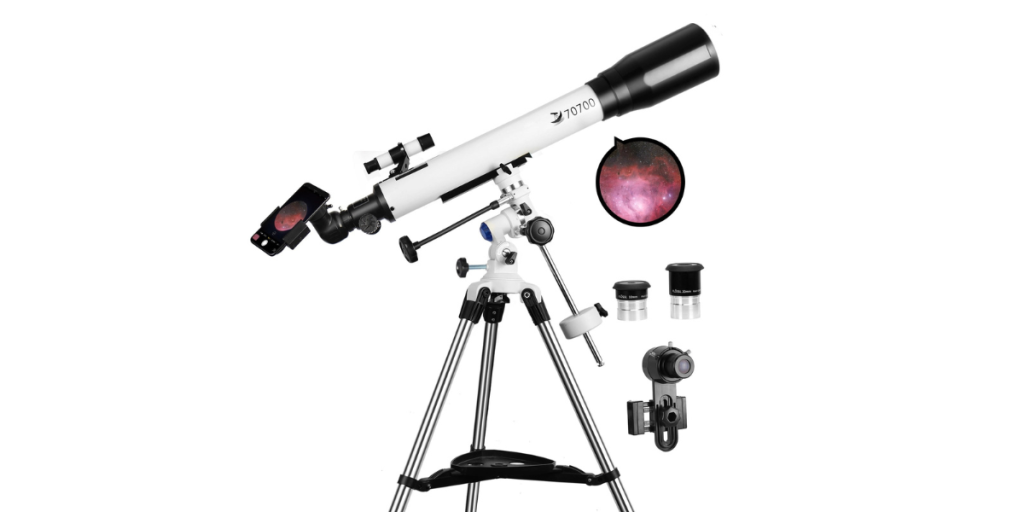
Telescopes, the windows to the universe, have been instrumental in expanding our understanding of the cosmos. From the earliest observations of celestial bodies to the cutting-edge technologies of modern space telescopes, these optical instruments have played a pivotal role in unraveling the mysteries of the universe. In this comprehensive exploration, we delve into the evolution of telescopes, the different types that exist, their contributions to astronomy, and the transformative impact they continue to have on our cosmic journey.
The Evolution of Telescopes:
1. The Birth of the Telescope:
- In the early 17th century, the invention of the telescope is attributed to Hans Lippershey, a Dutch eyeglass maker.
- Galileo Galilei’s use of the telescope for astronomical observations marked a revolutionary moment in the history of astronomy.
2. Refracting Telescopes:
- Early telescopes were refracting telescopes, utilizing lenses to bend and focus light.
- Galileo’s telescope was a refracting telescope, revealing the moons of Jupiter and the phases of Venus.
3. Reflecting Telescopes:
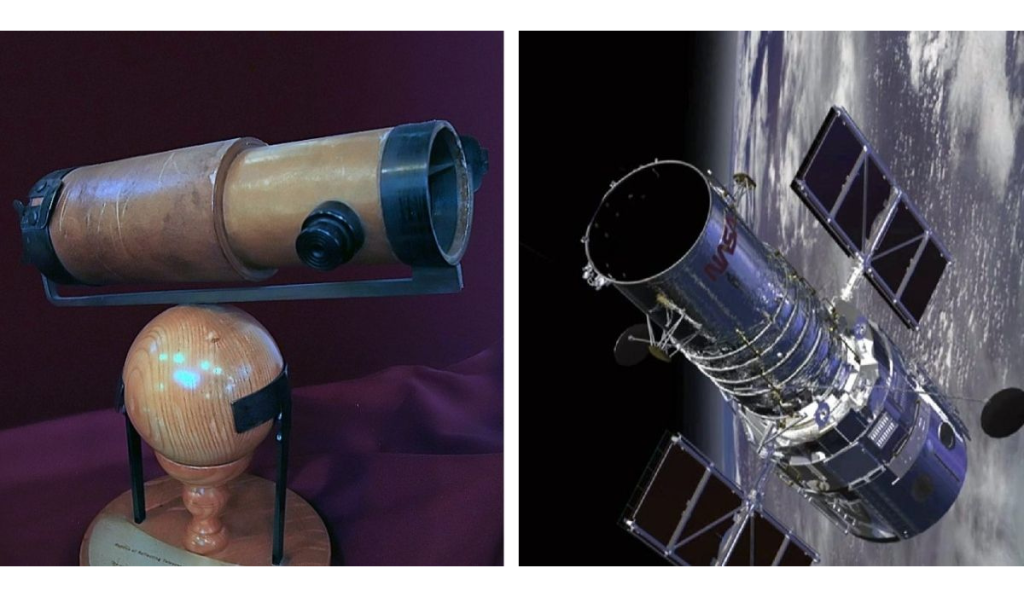
- In the 17th century, Isaac Newton designed the first reflecting telescope, using mirrors instead of lenses.
- Reflecting telescopes became popular due to their elimination of chromatic aberration.
4. The Hubble Space Telescope:
- Launched in 1990, the Hubble Space Telescope revolutionized space-based astronomy.
- Its images have provided unprecedented views of distant galaxies, nebulae, and other cosmic phenomena.
Types of Telescopes and Their Applications:
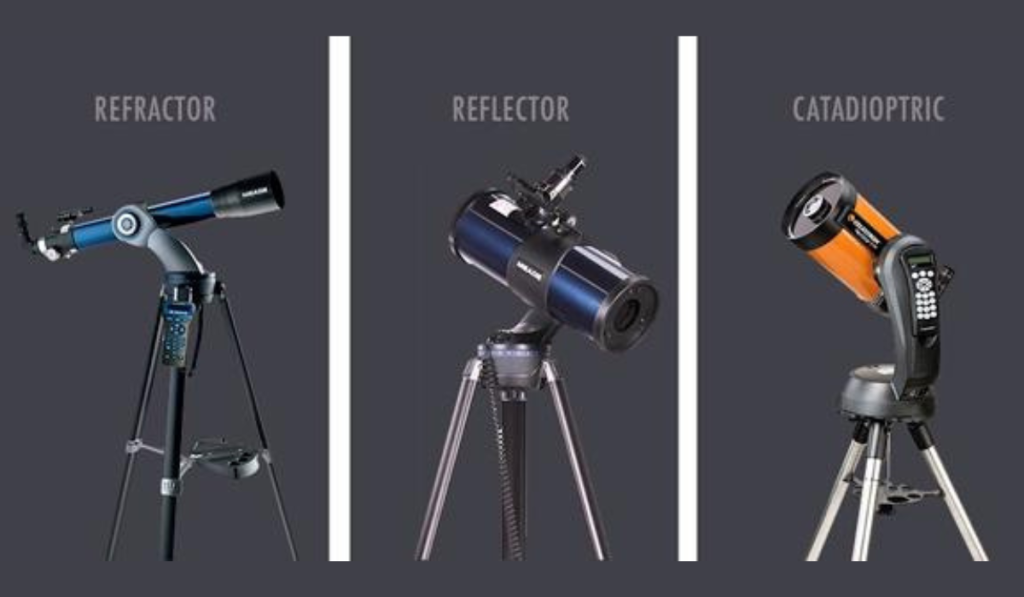
5. Refracting Telescopes:
- Apochromatic Refractors: Correct chromatic aberration, providing high-quality images for astrophotography.
- Achromatic Refractors: Use lenses to bend and focus light, suitable for planetary and lunar observations.
6. Reflecting Telescopes:
- Newtonian Telescopes: Commonly used for amateur astronomy, featuring a parabolic primary mirror.
- Dobsonian Telescopes: A type of Newtonian telescope with a simplified mount, popular for their affordability and ease of use.
7. Compound Telescopes:
- Schmidt-Cassegrain Telescopes (SCT): Combine lenses and mirrors, providing a compact design with a long focal length.
- Maksutov-Cassegrain Telescopes: Similar to SCTs but with a different optical design, offering excellent image quality.
8. Radio Telescopes:
- Observe radio waves emitted by celestial objects.
- The Very Large Array (VLA) in New Mexico is a prominent example.
9. Space Telescopes:
- Chandra X-ray Observatory: Observes X-rays from high-energy regions of the universe.
- Spitzer Space Telescope: Infrared telescope studying cool objects in space.
10. Ground-Based Observatories:
- Keck Observatory: Features two of the world’s largest optical and infrared telescopes.
- Atacama Large Millimeter Array (ALMA): An array of radio telescopes in Chile, observing millimeter and submillimeter wavelengths.
Contributions to Astronomy:
11. Discovery of Exoplanets:
- Telescopes have played a crucial role in discovering exoplanets, planets outside our solar system.
- The Kepler Space Telescope identified thousands of exoplanet candidates.
12. Mapping the Cosmos:
- Telescopes contribute to mapping the universe, revealing the large-scale structure of galaxies.
- Sky surveys, like the Sloan Digital Sky Survey, provide extensive catalogs of celestial objects.
13. Studying Stellar Evolution:
- Telescopes observe stars at various stages of their life cycle, providing insights into stellar evolution.
- Supernova observations contribute to understanding the explosive deaths of massive stars.
14. Cosmological Research:
- Telescopes aid in cosmological research, exploring the nature of dark matter and dark energy.
- Observations of the cosmic microwave background provide clues about the early universe.
15. Deep Field Observations:
- Telescopes conduct deep field observations, capturing images of the most distant galaxies.
- The Hubble Ultra-Deep Field is a remarkable example of such observations.
Technological Advancements:
16. Adaptive Optics:
- Corrects distortions caused by Earth’s atmosphere, enhancing the clarity of astronomical observations.
- Allows telescopes to achieve higher resolutions.
17. Interferometry:
- Combines signals from multiple telescopes to create a virtual telescope with improved resolution.
- Very Long Baseline Interferometry (VLBI) enables observations with global telescope networks.
18. Gravitational Wave Astronomy:
- Telescopes collaborate with gravitational wave detectors, such as LIGO and Virgo.
- Simultaneous observations of electromagnetic and gravitational wave signals provide a comprehensive view of cosmic events.
19. Future Telescopes:
- The James Webb Space Telescope, set to launch, promises to be the successor to the Hubble Space Telescope.
- Extremely Large Telescopes (ELTs), like the European Southern Observatory’s ELT, aim to push the boundaries of observational capabilities.
Frequently Asked Questions (FAQs):
Q1: How do telescopes work?
A1: Telescopes collect and magnify light, allowing astronomers to observe distant objects. Refracting telescopes use lenses to bend and focus light, while reflecting telescopes use mirrors. Different types of telescopes are designed for specific purposes, such as observing planets, stars, or deep space objects.
Q2: What is the difference between a refracting and reflecting telescope?
A2: Refracting telescopes use lenses to bend and focus light, while reflecting telescopes use mirrors. Refracting telescopes are prone to chromatic aberration, which is corrected in apochromatic designs. Reflecting telescopes eliminate chromatic aberration, making them popular for astronomical observations.
Q3: Can I observe celestial objects with a backyard telescope?
A3: Yes, backyard telescopes are excellent for observing planets, the Moon, and some deep-sky objects. They provide opportunities to explore the night sky and are popular among amateur astronomers.
Q4: How do space telescopes differ from ground-based telescopes?
A4: Space telescopes, like the Hubble Space Telescope, orbit Earth, avoiding atmospheric distortions. They can observe ultraviolet and infrared wavelengths, which are absorbed by Earth’s atmosphere. Ground-based telescopes are limited by atmospheric conditions but are essential for certain observations.
Q5: How does adaptive optics improve telescope performance?
A5: Adaptive optics corrects distortions caused by Earth’s atmosphere. By adjusting the telescope’s mirrors in real time, adaptive optics enhance image clarity, allowing telescopes to achieve higher resolutions.
Q6: What is the significance of gravitational wave astronomy?
A6: Gravitational wave astronomy complements traditional telescope observations. Gravitational wave detectors, like LIGO and Virgo, detect ripples in spacetime caused by cosmic events. Simultaneous observations with telescopes provide a more comprehensive understanding of these events.
Q7: How does interferometry work in astronomy?
A7: Interferometry combines signals from multiple telescopes, creating a virtual telescope with improved resolution. This technique enhances observational capabilities, allowing astronomers to study fine details of celestial objects.
Q8: Why are extremely large telescopes (ELTs) significant?
A8: Extremely Large Telescopes, like the ELT under construction by the European Southern Observatory, have larger apertures, enabling them to gather more light and observe fainter objects. ELTs aim to push the boundaries of observational capabilities and contribute to groundbreaking discoveries.
Q9: How has the James Webb Space Telescope been designed to overcome limitations?
A9: The James Webb Space Telescope (JWST) is designed to observe in the infrared spectrum and will orbit the second Lagrange point (L2), avoiding Earth’s heat and allowing for more precise observations. Its advanced technologies aim to surpass the capabilities of its predecessor, the Hubble Space Telescope.
Q10: Can I contribute to astronomical discoveries with a small telescope?
A10: Yes, amateur astronomers regularly contribute valuable observations to the field. Small telescopes can be used for monitoring variable stars, observing planets, and capturing images of celestial events. Citizen science projects also engage enthusiasts in scientific research.
Conclusion:
Telescopes, ranging from the humblest backyard instrument to the colossal space-based observatories, continue to be humanity’s eyes on the cosmos. From the cradle of optical astronomy to the frontiers of gravitational wave detection, telescopes have been at the forefront of groundbreaking discoveries. As technology advances and new generations of telescopes take center stage, the cosmic journey unfolds with unprecedented clarity. Each telescope, whether gazing into the depths of space or exploring our celestial neighbors, adds another layer to the rich tapestry of astronomical knowledge. The story of telescopes is not just about observing the universe; it’s about our relentless pursuit to comprehend the vastness and complexity of the cosmos that surrounds us.
Related Links: Centrifuges


