







Unveiling the Wonders of Space: Fascinating Science Facts 2024

Space, the final frontier, has captivated humanity for centuries with its vastness, mysteries, and wonders. From distant galaxies to the depths of black holes, the universe is a treasure trove of scientific discoveries waiting to be unearthed. In this article, we embark on a journey through space, exploring captivating science facts that illuminate our understanding of the cosmos. Additionally, we address frequently asked questions (FAQs) to unravel some of the mysteries surrounding space exploration and discovery.
I. Introduction to Space Science
1. The Cosmos Beyond Earth:
- Space science encompasses the study of celestial objects, phenomena, and the vast expanse of the universe beyond Earth’s atmosphere.
- It encompasses various disciplines, including astronomy, astrophysics, cosmology, and planetary science, all aimed at unraveling the mysteries of the cosmos.
2. Pioneering Discoveries:
- Throughout history, humanity has made remarkable discoveries about space, from the heliocentric model proposed by Copernicus to the landing of astronauts on the Moon during the Apollo missions.
II. Fascinating Science Facts About Space
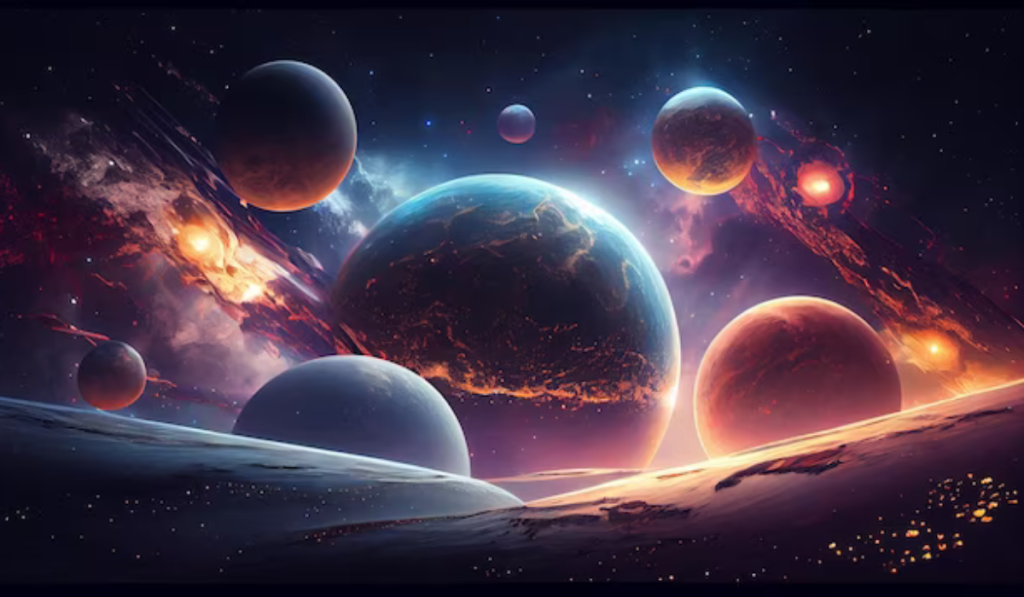
1. Cosmic Scale:
- The universe is estimated to be approximately 13.8 billion years old, with galaxies, stars, and planets spread across vast cosmic distances.
- The observable universe spans billions of light-years, containing billions of galaxies, each with billions of stars and countless planets.
2. Black Holes:
- Black holes are regions of spacetime where gravitational forces are so strong that nothing, not even light, can escape.
- Supermassive black holes, millions or even billions of times more massive than the Sun, reside at the centers of most galaxies.
3. Exoplanets:
- Exoplanets, or extrasolar planets, are planets orbiting stars outside our solar system.
- Thousands of exoplanets have been discovered, ranging from rocky worlds like Earth to gas giants similar to Jupiter.
4. Cosmic Phenomena:
- Space is home to a myriad of fascinating phenomena, including supernovae explosions, gamma-ray bursts, and neutron stars.
- These cosmic events offer insights into the life cycles of stars and the underlying physics of the universe.
5. Dark Matter and Dark Energy:
- Dark matter and dark energy constitute the majority of the universe’s mass-energy content, yet their nature remains largely mysterious.
- Dark matter exerts gravitational influence on galaxies, while dark energy drives the accelerated expansion of the universe.
III. FAQs About Space Science
Q1: How do scientists study distant objects in space?
A1: Scientists use telescopes, both ground-based and space-based, to observe celestial objects across different wavelengths of light, from radio waves to gamma rays. They also employ spacecraft and robotic missions to explore planets, moons, and other celestial bodies up close.
Q2: Are there other habitable planets beyond our solar system?
A2: Scientists have discovered thousands of exoplanets, some of which may possess conditions conducive to life. The search for habitable exoplanets continues, with missions like the Kepler Space Telescope and the upcoming James Webb Space Telescope aiming to identify potentially habitable worlds.
Q3: What is the Big Bang theory?
A3: The Big Bang theory is the prevailing cosmological model that describes the origin and evolution of the universe. It posits that the universe began as a hot, dense singularity approximately 13.8 billion years ago and has been expanding and cooling ever since.
Q4: How do black holes form?
A4: Black holes form from the gravitational collapse of massive stars at the end of their life cycles. When a star’s core runs out of nuclear fuel, it can no longer support itself against gravity, leading to a catastrophic collapse and the formation of a black hole.
Q5: What role does space exploration play in advancing scientific knowledge?
A5: Space exploration allows scientists to study the cosmos firsthand, expanding our understanding of the universe, its origins, and its fundamental processes. Additionally, space technologies developed for exploration have practical applications in fields such as medicine, communications, and environmental monitoring.
IV. Conclusion: Exploring the Cosmos
As we gaze up at the night sky, we are reminded of the boundless wonders that await exploration beyond our planet. Space science continues to push the boundaries of human knowledge, revealing the secrets of the universe and inspiring generations to reach for the stars. Through ongoing research, discovery, and exploration, we embark on an exhilarating journey of cosmic exploration, unraveling the mysteries of space one discovery at a time.
Related link: Factorio Space Science


