







Black Holes: A Comprehensive Exploration of Black Holes 2024
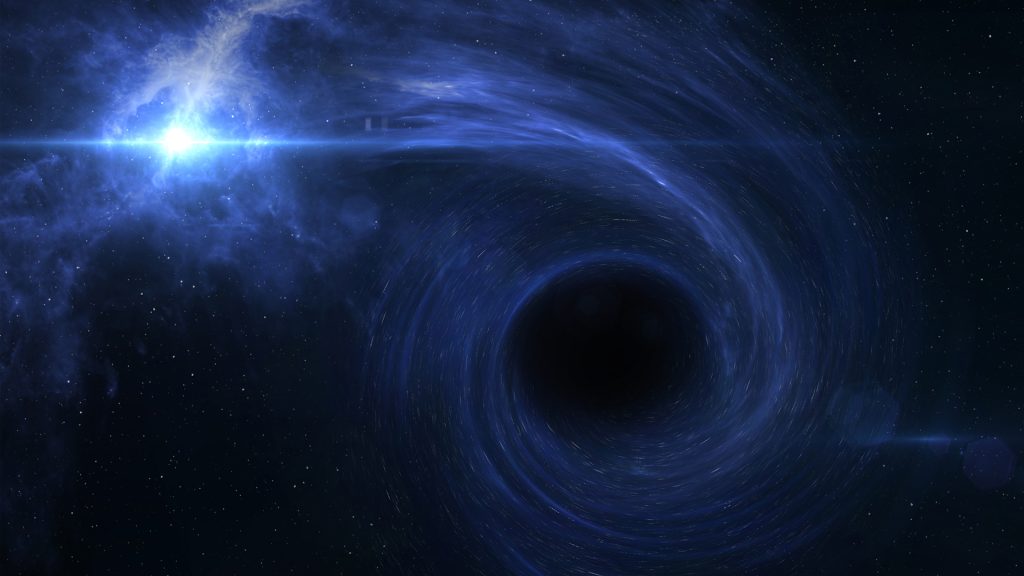
In the cosmic theater of celestial wonders, few entities evoke as much intrigue, awe, and mystery as black holes. These enigmatic cosmic phenomena, where gravity reaches its zenith, warp space and time, and devour everything in their vicinity, have fascinated scientists and stargazers alike. This comprehensive journey into the heart of black holes explores their nature, formation, classifications, and the profound implications they hold for our understanding of the cosmos.
Unveiling the Abyss: Defining Black Holes
1. Defying the Ordinary: What is a Black Hole?
- Black holes are regions of spacetime where gravity is so intense that nothing, not even light, can escape their gravitational pull.
- They are born from the remnants of massive stars that undergo gravitational collapse.
2. The Fabric of Spacetime: General Relativity’s Role
- Albert Einstein’s theory of general relativity forms the foundation of our understanding of gravity and the warping of spacetime.
- Black holes are a direct consequence of the extreme conditions predicted by general relativity.
3. Singularity and Event Horizon: Core Characteristics
- At the heart of a black hole lies a singularity, a point of infinite density where the laws of physics break down.
- The event horizon is the boundary beyond which escape is impossible, marking the point of no return.
Formation and Types of Black Holes
4. Birth of a Black Hole: Stellar Collapse
- Most black holes are formed from the gravitational collapse of massive stars at the end of their life cycle.
- The core collapse results in the formation of a singularity surrounded by the event horizon.
5. Stellar Mass, Intermediate, and Supermassive Black Holes
- Stellar Mass Black Holes: Formed from collapsing massive stars, these have masses ranging from a few times that of the Sun to around 20 solar masses.
- Intermediate Black Holes: Their existence is theorized, with masses between 100 and 1000 times that of the Sun.
- Supermassive Black Holes: Found at the centers of galaxies, these giants have masses millions to billions of times that of the Sun.
6. Primordial and Micro Black Holes: Exotic Possibilities
- Primordial Black Holes: Hypothetical black holes that could have formed in the early universe due to high-density regions.
- Micro Black Holes: Theoretical entities that could exist on microscopic scales, potentially formed in the early moments of the universe.
Properties and Behavior of Black Holes
7. No-Hair Theorem: Simplicity in Complexity
- The no-hair theorem suggests that black holes can be characterized by only three properties: mass, electric charge, and angular momentum.
- Other details about the infalling matter are lost to the singularity.
8. Accretion Disks and Jets: Cosmic Feeding Frenzy
- As black holes pull in surrounding matter, accretion disks form, emitting intense radiation.
- Jets of high-speed particles are often observed, extending far beyond the event horizon.
9. Spinning Black Holes: Ergosphere and Frame-Dragging
- Spinning black holes, or Kerr black holes, exhibit an ergosphere, a region outside the event horizon where objects cannot remain stationary.
- Frame-dragging occurs, causing spacetime to twist around a rotating black hole.
Observational Techniques and Discoveries
10. X-ray Binaries and Gravitational Waves: Indirect Evidence
- X-ray binaries, consisting of a normal star and a black hole, emit X-rays as matter is pulled from the star.
- Gravitational wave observatories, like LIGO and Virgo, have detected ripples in spacetime caused by the merger of black hole binaries.
11. Event Horizon Telescope: Capturing the Unseen
- The Event Horizon Telescope (EHT) captured the first image of a black hole’s shadow in the center of the galaxy M87.
- This groundbreaking achievement provided a visual confirmation of the existence of black holes.
The Cosmic Significance of Black Holes
12. Cosmic Recycling: Black Holes and Galaxy Evolution
- Supermassive black holes at galactic centers play a crucial role in regulating star formation and galaxy evolution.
- The interplay between black holes and galaxies is an intricate dance with profound consequences.
13. Cosmic Conundrums: Information Paradox and Hawking Radiation
- The information paradox questions what happens to information that falls into a black hole.
- Hawking radiation, predicted by Stephen Hawking, suggests that black holes can emit radiation and gradually lose mass.
14. Interstellar Wormholes and Black Hole Travel: Speculative Frontiers
- Theoretical concepts like wormholes, shortcuts through spacetime, and black hole travel capture the imagination.
- The practicality and feasibility of these ideas remain speculative and face significant challenges.
Frequently Asked Questions (FAQs)
Q1: Can anything escape a black hole?
A1: Once something crosses the event horizon of a black hole, it cannot escape, not even light. This is due to the extreme gravitational pull.
Q2: Do black holes move through space?
A2: Yes, black holes can move through space like any other massive object. Their motion is influenced by the gravitational forces acting on them.
Q3: What is the biggest black hole discovered
?
A3: The largest known black holes are supermassive black holes found at the centers of galaxies. Some of these can have masses billions of times that of the Sun.
Q4: How are black holes detected?
A4: Black holes are detected through their gravitational influence on nearby matter, such as in binary systems, and by the radiation emitted from accretion disks. Gravitational wave observatories have also detected black hole mergers.
Q5: Can a black hole destroy the entire universe?
A5: No, a single black hole cannot destroy the entire universe. However, the role of black holes in the long-term fate of the universe is a subject of cosmological study.
Q6: What happens inside a black hole?
A6: Inside a black hole, the laws of physics as we know them break down. The singularity at the center is a point of infinite density, and our current understanding cannot describe the conditions within.
Q7: Can black holes die?
A7: Black holes can lose mass through Hawking radiation over extremely long periods. Small black holes might eventually evaporate, but larger ones have extremely long lifetimes.
Q8: Is time different near a black hole?
A8: According to general relativity, time near a massive object like a black hole is dilated, meaning it appears to pass more slowly for an observer far from the black hole.
Q9: Could a black hole destroy Earth?
A9: A black hole would need to come very close to Earth to pose a threat, which is highly unlikely. Currently, there are no known black holes near our solar system.
Q10: Can we see inside a black hole?
A10: No, we cannot directly see inside a black hole because even light cannot escape from beyond the event horizon. Our observations are limited to the effects of black holes on surrounding matter.
Conclusion: Peering into the Cosmic Abyss
Black holes, with their captivating mystery and immense gravitational influence, stand as cosmic enigmas that challenge the very fabric of our understanding of space and time. From the dazzling dance of matter around stellar black holes to the colossal shadows cast by supermassive ones, these cosmic entities continue to reveal their secrets through innovative observations and theoretical explorations. As our journey into the cosmos unfolds, black holes remain celestial waypoints, beckoning us to delve deeper into the profound mysteries that shape the cosmic landscape.
Related links: Dark Matter


