







Solar System: A Comprehensive Journey through the Solar System 2024
Introduction:
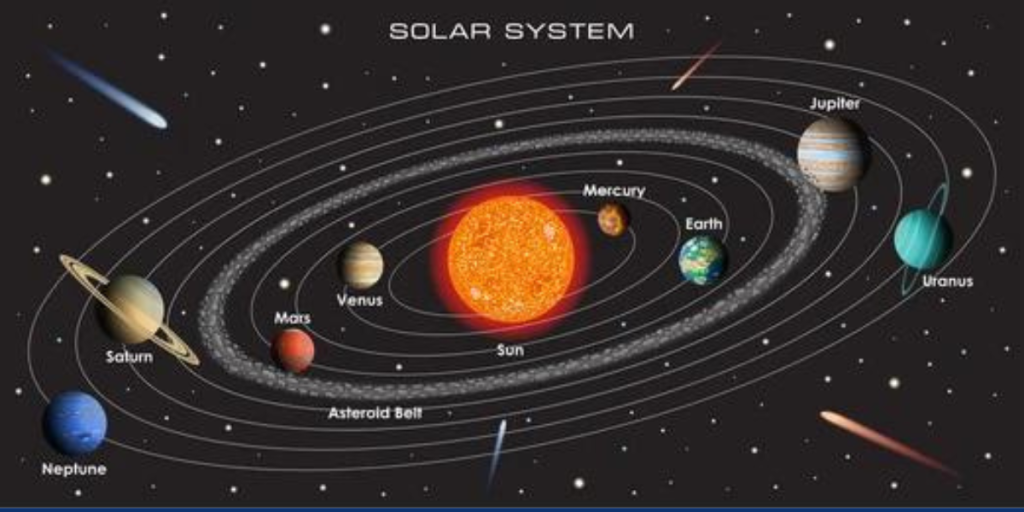
The solar system, a mesmerizing tapestry of celestial bodies and cosmic wonders, has captivated human imagination for centuries. From the blazing brilliance of the Sun to the distant realms of icy comets, our solar system is a dynamic and diverse expanse that offers a wealth of scientific exploration. In this extensive exploration, we will delve into the components of the solar system, their formation, the intricate dance of planets, moons, and asteroids, and the ongoing missions that deepen our understanding of this cosmic neighborhood.
I. Components of the Solar System:
1. The Sun:
At the heart of the solar system reigns the Sun, a dazzling, luminous sphere of hot plasma. It is not only the primary source of light and heat but also the gravitational anchor that governs the orbits of all other celestial bodies within the solar system.
2. Planets:
The solar system hosts eight major planets, each with unique characteristics and diverse compositions. These planets can be categorized into two groups:
a. Inner Planets (Terrestrial Planets):
- Mercury, Venus, Earth, and Mars constitute the inner planets.
- These planets are relatively small, rocky, and have solid surfaces.
- Earth, the third planet, stands out as the only known celestial body to support life.
b. Outer Planets (Gas Giants):
- Jupiter, Saturn, Uranus, and Neptune form the outer planets.
- These gas giants are larger, primarily composed of hydrogen and helium, and lack solid surfaces.
3. Dwarf Planets:
Beyond the eight major planets, the solar system harbors a diverse array of dwarf planets. Pluto, once considered the ninth planet, is now classified as a dwarf planet, along with others like Eris and Haumea.
4. Moons:
Numerous moons, ranging from small, irregular rocks to large, geologically active worlds, orbit the planets. Earth’s moon, Europa (moon of Jupiter), and Titan (moon of Saturn) are among the captivating moons that intrigue scientists and astronomers.
5. Asteroids and Comets:
Asteroids, rocky remnants from the early solar system, orbit the Sun, with the asteroid belt situated between Mars and Jupiter. Comets, icy bodies originating from the outer regions, showcase beautiful tails when close to the Sun.
II. Formation and Evolution:
1. Solar Nebula Hypothesis:
The solar system’s formation is attributed to the Solar Nebula Hypothesis. Approximately 4.6 billion years ago, a massive molecular cloud collapsed, giving rise to a rotating disk of gas and dust—the solar nebula.
2. Protostar Formation:
At the center of the solar nebula, a dense region accumulated to form the protostar—the early version of the Sun. Intense heat and pressure triggered nuclear fusion, igniting the Sun and initiating the solar system’s formation.
3. Planetesimal Formation:
Within the rotating disk, tiny particles collided and accreted to form planetesimals—precursors to planets. These planetesimals continued to collide and merge, giving rise to the diverse array of celestial bodies present in the solar system.
4. Planetary Migration:
Some planets experienced migration during their formation. Jupiter, for instance, migrated inward before moving outward, influencing the orbits of other planets and shaping the architecture of the solar system.
III. The Inner Planets:
1. Mercury:
Mercury, the closest planet to the Sun, is a rocky world with extreme temperature variations. Its surface is marked by craters, and it has minimal atmosphere.
2. Venus:
Venus, often referred to as Earth’s “sister planet,” shares a similar size and composition. However, its thick atmosphere traps heat, resulting in a scorching surface temperature.
3. Earth:
Earth, the only known celestial body supporting life, boasts a diverse environment of oceans, continents, and a life-sustaining atmosphere. It orbits the Sun at an optimal distance, known as the habitable zone.
4. Mars:
Mars, often called the “Red Planet” due to its rusty surface, has polar ice caps and a thin atmosphere. Ongoing exploration seeks evidence of past or present microbial life.
IV. The Outer Planets:
1. Jupiter:
Jupiter, the largest planet, is a gas giant with a dynamic atmosphere and a prominent system of rings. Its Great Red Spot, a massive storm, has been observed for centuries.
2. Saturn:
Saturn, renowned for its stunning ring system, is another gas giant. Its rings are composed of icy particles, and the planet has a diverse collection of moons.
3. Uranus:
Uranus, an ice giant, has a unique feature—its rotational axis is tilted almost parallel to its orbit, leading to extreme seasons. It is surrounded by a set of faint rings.
4. Neptune:
Neptune, the farthest major planet from the Sun, is also an ice giant. It exhibits strong winds and a distinctive dark storm called the Great Dark Spot.
V. Dwarf Planets, Moons, and Small Bodies:
1. Pluto:
Once considered the ninth planet, Pluto is now classified as a dwarf planet in the Kuiper Belt—a region beyond Neptune. It has five moons, including Charon.
2. Charon:
Charon is the largest moon of Pluto and forms a binary system with it. The New Horizons mission provided detailed images of Pluto and Charon in 2015.
3. Europa:
Europa, a moon of Jupiter, has a global subsurface ocean beneath its icy crust. It is a prime target in the search for potential extraterrestrial life.
4. Titan:
Titan, Saturn’s largest moon, has a thick atmosphere and lakes of liquid hydrocarbons on its surface. It is a fascinating target for exploration.
5. Asteroid Belt:
Situated between Mars and Jupiter, the asteroid belt is a region containing numerous asteroids—rocky remnants from the early solar system.
6. Kuiper Belt:
Beyond Neptune lies the Kuiper Belt, a region populated with icy bodies and dwarf planets, including Pluto. It provides insights into the solar system’s distant past.
VI. Solar System Exploration:
1. Voyager Missions:
Launched in the late 1970s, the Voyager 1 and Voyager 2 spacecraft explored the outer planets and their moons. They provided valuable data on the characteristics of these distant worlds.
2. Mars Rovers:
Rovers like Spirit, Opportunity, and Curiosity have extensively explored the Martian surface, providing crucial information about Mars’ geology and potential habitability.
3. Cassini-Huygens:
The Cassini spacecraft studied Saturn and its moons for over 13 years. The Huygens probe successfully landed on Titan, providing unprecedented insights into this enigmatic moon.
4. New Horizons:
Launched in 2006, New Horizons conducted a historic flyby of Pluto in 201
5, capturing detailed images and data about the dwarf planet and its moons.
5. Juno:
The Juno spacecraft has been orbiting Jupiter since 2016, studying the planet’s atmosphere, magnetic field, and interior structure.
6. Ongoing and Future Missions:
Numerous missions, including the Mars Perseverance Rover, the James Webb Space Telescope, and the Europa Clipper, promise to unveil more secrets of our solar system in the coming years.
VII. Solar System FAQs:
Q1: How old is the solar system?
A1: The solar system is approximately 4.6 billion years old, dating back to the formation of the Sun and the protoplanetary disk from which the planets and other celestial bodies emerged.
Q2: Why is Pluto no longer considered a planet?
A2: In 2006, the International Astronomical Union redefined the criteria for classifying planets. Pluto did not meet the new definition, primarily due to its size and its inability to clear its orbit of other debris, leading to its reclassification as a dwarf planet.
Q3: How does the solar system move through the Milky Way?
A3: The solar system, including the Sun and its planets, orbits around the center of the Milky Way galaxy. This orbital motion takes hundreds of millions of years to complete.
Q4: Can life exist on other planets or moons in the solar system?
A4: The search for extraterrestrial life within the solar system focuses on environments with potential habitability, such as the subsurface oceans of Europa and Enceladus. The presence of liquid water is considered a key factor in the search for life.
Q5: What causes the seasons on Earth?
A5: Earth’s axial tilt and its orbit around the Sun cause the changing seasons. As Earth orbits the Sun, different parts of the planet receive varying amounts of sunlight, leading to the cycle of seasons.
Q6: How are comets different from asteroids?
A6: Comets are icy bodies that originate from the outer regions of the solar system and develop tails when heated by the Sun. Asteroids, on the other hand, are rocky remnants primarily found in the asteroid belt between Mars and Jupiter.
Q7: What is the Great Red Spot on Jupiter?
A7: The Great Red Spot is a massive storm on Jupiter, observed since the 17th century. It is an anticyclonic storm, larger than Earth, and its exact mechanisms and persistence remain topics of scientific study.
Q8: How do scientists study distant objects in the solar system?
A8: Scientists study distant objects in the solar system using telescopes, both ground-based and space-based, as well as robotic spacecraft. Space missions provide close-up observations and analyses of planets, moons, and other celestial bodies.
Conclusion:
The solar system, with its myriad planets, moons, asteroids, and comets, stands as a testament to the cosmic beauty and complexity of our celestial neighborhood. Through centuries of exploration and technological advancement, humanity has unraveled many mysteries, yet the solar system continues to be a source of fascination and scientific inquiry. As we embark on future missions and delve deeper into the wonders of our cosmic home, the solar system remains a rich tapestry waiting to reveal new chapters in the ongoing saga of our place in the universe.
Related link: Planetary Science


