







How Catalysts Speed Up Reactions: Key Insights
 How Catalysts Speed Up Reactions: A visual guide explaining their role in chemical processes.
In the fascinating world of chemistry, reactions drive numerous essential processes, from the food we consume to the energy we use. However, many chemical reactions happen at a pace that would be far too slow for practical purposes. This is where catalysts play a crucial role. Catalysts are substances that speed up chemical reactions by lowering the activation energy needed for the reaction to occur. By doing so, they make processes faster and more efficient, helping to save time, energy, and resources.
Catalysts are widely used across various industries to improve the efficiency of chemical reactions. Whether it’s in the production of chemicals, the automotive industry through catalytic converters, or the pharmaceutical sector, catalysts are indispensable. Their ability to accelerate reactions under milder conditions is essential in creating cost-effective and sustainable solutions. In this article, we will delve into how catalysts work, the different types, and explore their real-world applications in everyday life and industry.
What Are Catalysts?
A catalyst is a substance that accelerates the rate of a chemical reaction without being consumed or permanently altered in the process. It achieves this by lowering the activation energy, which is the minimum energy required for reactants to undergo a reaction. By providing an alternative reaction pathway, catalysts allow more molecules to participate in the reaction, speeding up the process and making it more efficient. Importantly, catalysts are not used up during the reaction and can continue to facilitate multiple reaction cycles.
The role of a catalyst is crucial in both biological and industrial processes. In nature, enzymes serve as biological catalysts, enabling essential biochemical reactions to occur in living organisms. In industry, catalysts are used to enhance the efficiency of chemical processes, such as the production of ammonia, petroleum refining, and even in pollution control systems. Through their ability to accelerate reactions and reduce energy requirements, catalysts play a vital role in modern chemistry and technology.
The Concept of Activation Energy
Activation energy is the minimum energy needed for reactant molecules to collide with enough force to begin a chemical reaction. It acts as a barrier that must be overcome for the reactants to transform into products. Without sufficient activation energy, the molecules lack the energy to break bonds and form new ones, causing them to merely collide and bounce off each other without undergoing any transformation.
Catalysts help overcome this barrier by lowering the activation energy required for a reaction to take place. By providing an alternative reaction pathway, catalysts allow more reactant molecules to have enough energy to react, even under milder conditions such as lower temperatures or reduced pressure. This makes chemical reactions happen more quickly and efficiently, reducing the energy needed and speeding up processes, which is crucial in various industrial and biological systems.
How Catalysts Speed Up Reactions
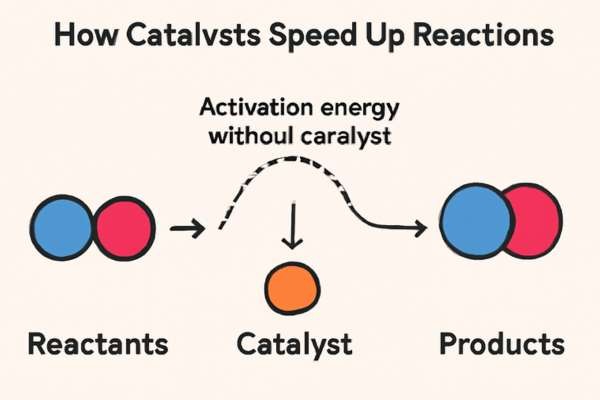
Catalysts play a crucial role in speeding up chemical reactions by lowering the activation energy. Activation energy is the minimum energy required for reactant molecules to collide with enough force to start a reaction. By providing an alternative reaction pathway with a lower energy barrier, catalysts make it easier for the reactants to convert into products. As a result, more reactant molecules have the necessary energy to overcome the barrier and undergo the reaction.
In reactions where the activation energy is high, only a small fraction of molecules can react at any given time. However, when a catalyst is introduced, it allows more molecules to participate in the reaction by lowering the energy needed. This increases the reaction rate, making the process more efficient. By facilitating reactions at lower temperatures or pressures, catalysts help save energy and reduce costs, making them invaluable in various chemical processes, from industrial applications to biological systems.
The Different Types of Catalysts
Catalysts come in various types, each playing a unique role depending on the chemical reaction involved.
Homogeneous Catalysts
Homogeneous catalysts are in the same phase as the reactants, usually in the form of a liquid or gas. These catalysts are often used in reactions where the reactants and the catalyst must mix well for the reaction to occur. An example of homogeneous catalysis is the use of acid catalysts in organic reactions like esterification.
Heterogeneous Catalysts
Heterogeneous catalysts exist in a different phase from the reactants. Typically, they are solids that catalyze reactions in liquid or gas phases. An example of heterogeneous catalysis is the use of solid metal catalysts, such as platinum in catalytic converters in cars, which convert harmful gases into less harmful emissions.
Enzyme Catalysts
Enzymes are biological catalysts found in living organisms. They are proteins that speed up biochemical reactions by lowering activation energy. Enzymes are highly specific and operate under mild conditions of temperature and pH, unlike many industrial catalysts that require harsh conditions. Without enzymes, vital processes such as digestion, DNA replication, and energy production would be far too slow to sustain life.
Catalysts and the Role of Chemical Kinetics
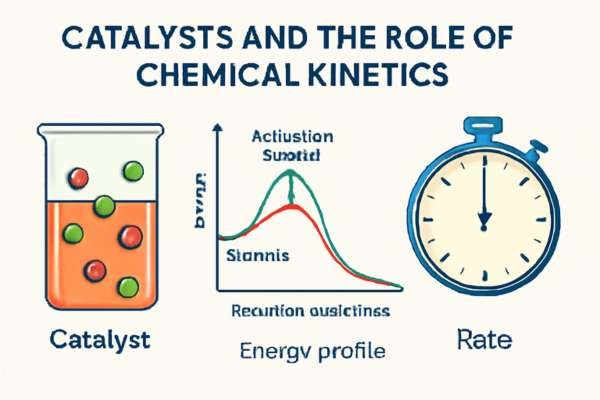
Chemical kinetics is a branch of chemistry that focuses on understanding how fast chemical reactions occur and what factors influence their speed. The study of reaction rates is crucial for optimizing industrial processes, improving efficiency, and designing new chemical reactions. Catalysts play a key role in chemical kinetics, as they help speed up reactions by lowering the activation energy, which is the energy barrier that reactants must overcome for a reaction to proceed.
By providing an alternative pathway with lower activation energy, catalysts increase the number of reactant molecules that can collide with enough energy to react. This results in a higher frequency of successful collisions, thus accelerating the reaction rate. Understanding how catalysts interact with reactants and influence reaction rates is an essential part of chemical kinetics. If you’re interested in exploring how different factors affect the speed of reactions, be sure to read our detailed article on Chemical Kinetics for more in-depth information.
The Mechanism Behind Catalysis
The catalytic process begins when the catalyst interacts with reactant molecules, forming a temporary bond that leads to the creation of an intermediate complex. This complex is crucial because it has a lower activation energy compared to the uncatalyzed reaction, allowing the reaction to proceed more easily. By stabilizing the transition state, the catalyst enables the reactants to convert into products faster, without requiring the high energy typically needed for such reactions.
Once the products are formed, the catalyst is released unchanged, ready to participate in another reaction cycle. This unique ability of catalysts to be reused multiple times without being consumed makes them incredibly valuable. In industrial settings, catalysts help drive chemical processes efficiently, while in biological systems, enzymes, as natural catalysts, support essential life-sustaining reactions. The repeatability of catalysis underpins its importance across various fields, providing sustainable solutions to many scientific and industrial challenges.
Real-World Applications of Catalysts
Catalysts are used in a wide range of industries, from energy production to environmental protection, and even in the food industry. One of the most significant industrial uses of catalysts is in the production of chemicals and pharmaceuticals. For example, in the manufacture of ammonia, the Haber-Bosch process relies on an iron catalyst to combine nitrogen and hydrogen gases to create ammonia, a key component of fertilizers.
In the energy sector, catalysts play a role in fuel cells, which convert chemical energy directly into electrical energy. By speeding up the reactions between hydrogen and oxygen, catalysts make these fuel cells more efficient, offering a cleaner alternative to traditional energy sources.
Catalysts also have a crucial environmental role, especially in reducing harmful emissions. Catalytic converters in vehicles use platinum and other metals to convert carbon monoxide, nitrogen oxides, and hydrocarbons into less harmful substances like carbon dioxide and water, significantly reducing pollution.
Catalysts in Everyday Life
Catalysts play a vital role in everyday life, often in ways we don’t immediately recognize. In our bodies, enzymes are the biological catalysts that facilitate crucial processes like digestion, metabolism, and the production of energy at the cellular level. These natural catalysts lower the activation energy required for biochemical reactions, enabling essential functions to occur at a rate that supports life. Without enzymes, these processes would be far too slow to keep us healthy and functioning.
In addition to their biological roles, catalysts are also used in various household products. For example, many detergents contain catalysts that help break down grease and stains more efficiently, improving cleaning performance. Similarly, catalytic reactions are essential in air purifiers, where they help remove harmful pollutants and improve air quality. Certain types of batteries also rely on catalysts to enhance energy production and extend battery life. Thus, catalysts impact both our health and daily conveniences in profound ways.
Advantages of Using Catalysts
The use of catalysts in chemical reactions offers several notable advantages. One of the most significant benefits is that they accelerate reactions without requiring additional energy inputs like heat or pressure. This reduction in energy consumption not only helps lower operational costs but also contributes to making chemical processes more environmentally sustainable. By lowering the activation energy, catalysts allow reactions to occur more efficiently at lower temperatures, reducing the overall energy demand.
Another major advantage of catalysts is their reusability, which makes them highly cost-effective for industrial applications. Since catalysts are not consumed during the reaction, they can be used repeatedly, facilitating numerous cycles of the same reaction. This feature is particularly valuable in large-scale operations where maintaining a constant supply of reactants and products is essential. By reducing waste and increasing reaction efficiency, catalysts play a key role in optimizing industrial processes while minimizing costs and environmental impact.
Challenges in Catalysis
Catalysts are essential in many industrial and biological processes, but their use is not without challenges. One significant issue is the deactivation of catalysts over time. Catalysts can lose their activity due to poisoning by impurities, which may block the active sites where reactions occur. Additionally, catalysts can undergo structural changes during use, causing them to become less effective. This problem is especially prevalent in heterogeneous catalysts, which operate by interacting with reactants on their surface.
To address these challenges, researchers are focused on developing more robust and durable catalysts. By understanding the factors that lead to catalyst deactivation, scientists can design catalysts that are less prone to poisoning and more resistant to structural changes. Ongoing research aims to improve catalyst efficiency, extend their lifespan, and enable them to perform well under a wider range of conditions, ultimately making industrial processes more sustainable and cost-effective.
Future Trends in Catalysis
The future of catalysis is poised to revolutionize both industry and environmental solutions. Researchers are delving into innovative materials, such as nanomaterials and biomimetic catalysts, which can function more efficiently and under milder conditions than traditional catalysts. These advancements promise to reduce energy consumption and improve the overall effectiveness of chemical processes. Additionally, catalysts capable of capturing carbon dioxide and converting it into useful products are gaining attention, offering a potential solution to mitigate climate change and lower greenhouse gas emissions.
Another promising area of research is the development of catalysts for clean energy production, particularly hydrogen fuel cells. By enhancing the performance of these catalysts, energy production could become more sustainable and environmentally friendly. As research progresses, we may see a significant shift towards clean, renewable energy sources, driven by more efficient catalysts that support global efforts to reduce our carbon footprint and achieve sustainability goals.
Final Thoughts
Catalysts are fundamental to the success of numerous chemical processes, from natural biological reactions to large-scale industrial applications. By reducing activation energy and offering alternative reaction pathways, catalysts make chemical reactions faster, more efficient, and less energy-intensive. Their widespread impact can be seen across industries such as pharmaceuticals, energy, environmental protection, and even in our everyday lives, from the digestion of food to pollution control.
As ongoing research explores new catalytic materials and mechanisms, the importance of catalysts in addressing global challenges will only grow. Understanding how catalysts work and their various applications can provide crucial insights into how we can leverage their potential for a more sustainable, efficient future. The continued development of catalysts will play a key role in advancing cleaner energy technologies, reducing waste, and mitigating environmental impact, making them essential for progress in many scientific and industrial fields.
FAQs
What is a catalyst?
A catalyst is a substance that speeds up the rate of a chemical reaction by lowering the activation energy required for the reaction to take place. It is not consumed in the reaction and can be used repeatedly.
How do catalysts work in a chemical reaction?
Catalysts work by providing an alternative reaction pathway with a lower activation energy. This allows more reactant molecules to have sufficient energy to react, thereby speeding up the overall reaction.
What is activation energy?
Activation energy is the minimum energy required for reactant molecules to collide with enough force to start a chemical reaction. It acts as an energy barrier that must be overcome for the reaction to proceed.
What are the different types of catalysts?
The main types of catalysts are homogeneous catalysts (same phase as reactants), heterogeneous catalysts (different phase than reactants), and enzyme catalysts (biological catalysts).
Can a catalyst be used for more than one reaction?
Yes, a catalyst can be used for multiple reactions. Since it is not consumed in the reaction, it remains unchanged and can facilitate several cycles of the same or different reactions.
Are catalysts used in everyday life?
Yes, catalysts play a role in everyday life, especially in biological processes like digestion, where enzymes act as catalysts. They are also used in household products such as detergents and air purifiers.
How do enzymes function as catalysts in biological reactions?
Enzymes are highly specific proteins that catalyze biochemical reactions in living organisms. They speed up processes such as digestion and metabolism by lowering the activation energy and enabling reactions to occur at a faster rate under mild conditions.
Why are catalysts important in industrial processes?
Catalysts are crucial in industries because they make reactions faster and more efficient, reducing the need for high temperatures and pressures. They are used in processes like the production of chemicals, fuels, and fertilizers, saving energy and cost.
Can catalysts become “poisoned” or lose their effectiveness?
Yes, catalysts can lose their effectiveness over time. This can happen due to contamination by impurities, which may block the catalyst’s active sites or cause its surface to change. Regular maintenance or regeneration of the catalyst is often necessary.
What is the future of catalysts in science and technology?
The future of catalysts looks promising, with ongoing research focused on developing more efficient, sustainable, and durable catalysts. These advancements could help address global challenges like climate change by enabling more efficient energy production, carbon capture, and pollution control.


